ARCHITECT EXPLAINS
What Is New England Coastal Design?
A Guide to the Timeless Style
____________________
New England coastal design has little to do with nautical motifs and everything to do with natural materials, quiet palettes, thoughtful architecture, and rooms designed to age beautifully.
SEPTEMBER 7, 2026
BY: MARIA CEBAN


ON THIS PAGE:
Introduction
What Actually Defines the New England Coastal Look?
Materials Matter More Than Accessories
Forget Everything You Know About Blue
Why Texture Outworks Color
Let the Light Do Some of the Decorating
How to Bring New England Coastal Into Your Home
An Architect’s Perspective: Architecture VS Accents
The Bottom Line: Coastal Design Is Classy, Not Beachy
Ask most people to picture coastal design, and you’ll get the same answer: striped pillows, a piece of driftwood propped on a shelf, a ship’s wheel mounted over the mantel. It’s a tidy shorthand, and it’s also almost entirely wrong.
Walk into a well-done shingle-style home on the Cape, or a renovated farmhouse outside Newport, and you won’t find a single anchor motif anywhere in the place. What you’ll find instead is light-filled rooms, natural materials, and an unfussy elegance that feels like it’s been there for decades—because in a lot of cases, it has.
That’s the important part the souvenir-shop version of a “coastal” home misses entirely: this was never a style to apply to a house. “Coastal” is a way of building and furnishing that grew out of the region itself—old sea captains’ homes, weathered shingles, deep porches built to catch a breeze off the water. The decor follows the architecture here, not the other way around.
This edition of Salt & Still’s Architect Explains defines what the New England Coastal Design is and how you can bring it into your home, without having to purchase a home on the coast.
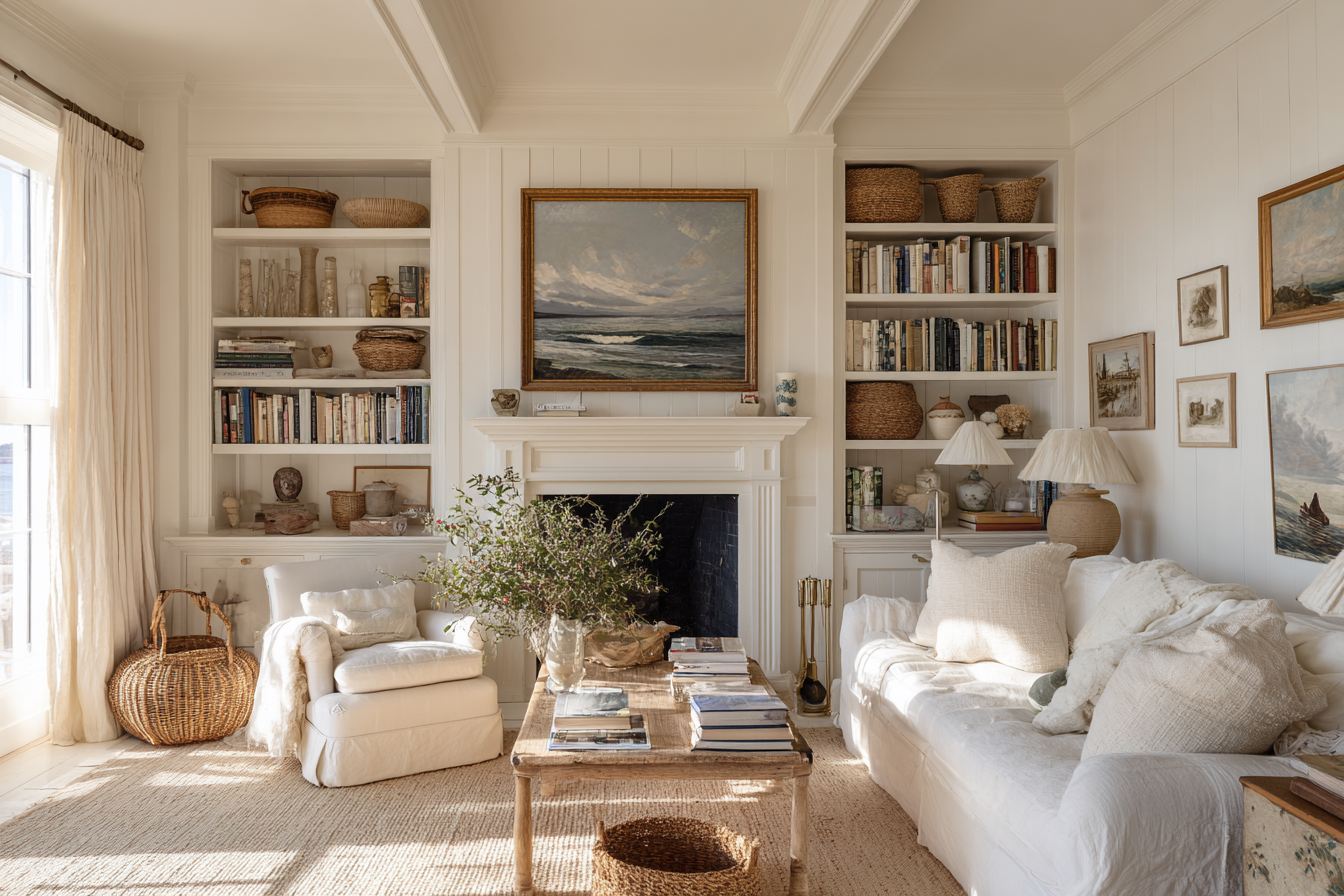
What you’ll find in a timeless New England coastal home is light-filled rooms, natural materials, and an unfussy elegance that feels like it’s been there for decades—because in a lot of cases, it has.
01 ———–
What Actually Defines the New England Coastal Look?
Strip away the clichés and assumptions, and a few real patterns show up again and again in the homes that get this style right:
- Reliance on natural materials and a few bold structural moves, rather than a pile of decorative accents.
- Color palettes that are complementary, soft and layered, not punchy.
- Texture doing most of the visual work.
- Furniture designed and built to be used, not just looked at.
- Architectural details that have some history to them.
- Rooms designed around how the light moves through them over the course of a day.
None of these require a single nautical stripe. Instead, what they require is restraint—the one ingredient the souvenir-shop version never has.
02 ———–
Materials Matter More Than Accessories
This is where most attempts at coastal design go wrong: people shop for the look instead of building it over time and connecting it to who they are and what their family values are.
A real coastal interior gets its character from what it’s made of: white oak floors, linen curtains that move when a window’s open, a chunky rattan chair, painted millwork, and stone left rough at the edges instead of polished smooth. None of those elements is decoration; they’re part of the room’s structure.
Materials and finishes are exactly where it pays to spend more money than feels comfortable—a laminate floor marketed “in a coastal finish” might look identical to reclaimed white oak in an advertisement photo, but the two age in opposite directions. One gets better looking with wear, while the other just gets worn out. If a renovation has this style in mind, the money belongs in the materials every room touches—floors, trim, textiles—long before it goes toward throw pillows.
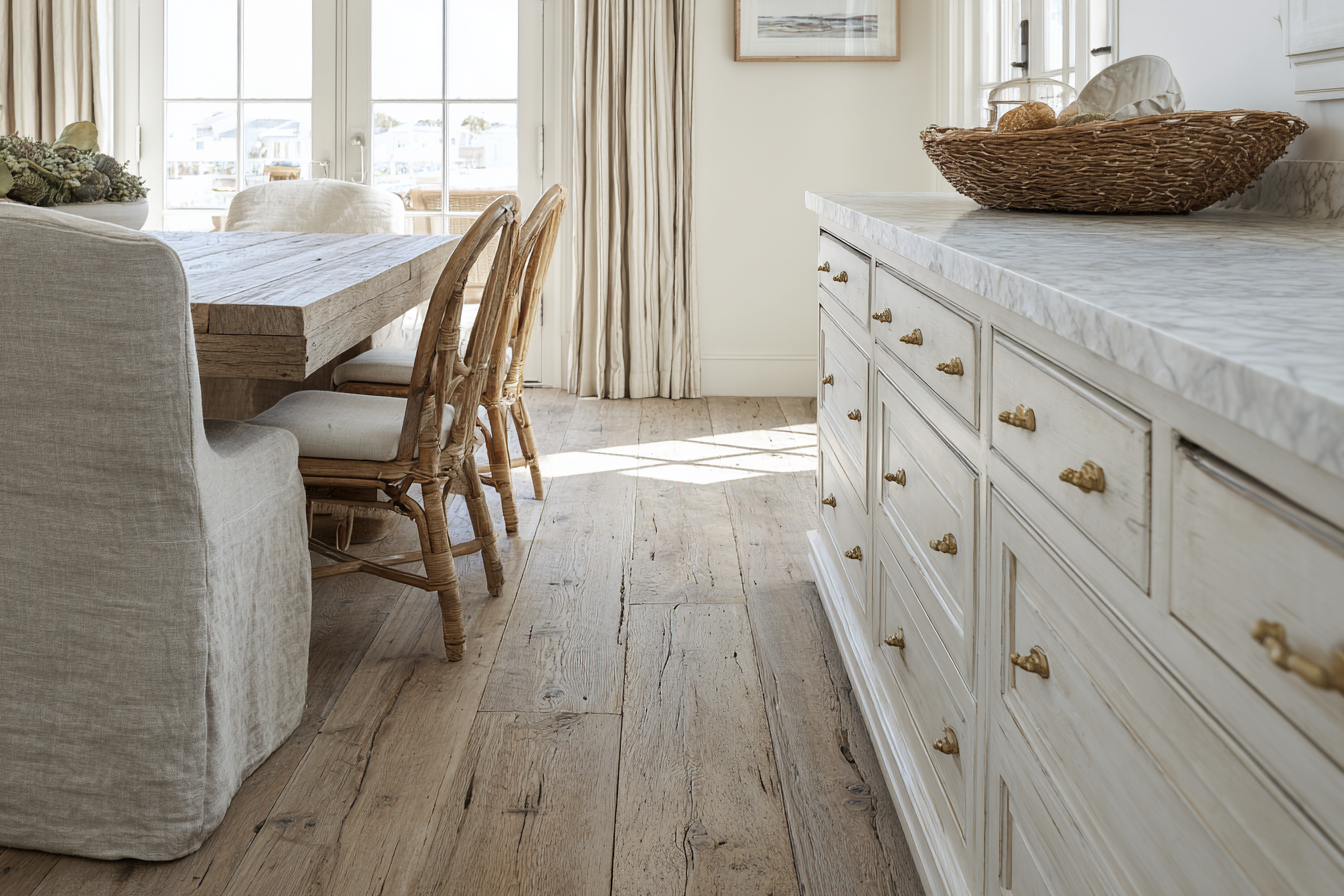
A real coastal interior gets its character from what it’s made of: white oak floors, linen curtains that actually move when a window’s open, a chunky rattan chair, painted millwork, and stone left rough at the edges instead of polished smooth.
03 ———–
Forget Everything You Know About Blue
At some point, “coastal” got flattened into navy-and-white-everything, and the style has been paying for it ever since.
Walk through the homes that actually nail this look, and the palette is almost always quieter than that:
- Warm whites.
- Soft creams.
- Sandy neutrals.
- Weathered, grayed-out wood tones.
- Muted sage and olive greens.
- Soft, warm grays.
Blue still has a place, it’s just not running the show. A room can have a navy lampshade, or a faded denim throw. Maybe one accent wall in a powder room may be deep blue, and nowhere else. Used sparingly, blue adds depth to a room, but when used everywhere, it tends to flatten the space into something that reads as showroom rather than home, no matter how good the furniture underneath it is.
The rooms that hold up—the ones that still look right five or ten years on, regardless of season—are almost always the ones that lean on these warmer, quieter tones and make blue earn its place instead of handing it the room outright.
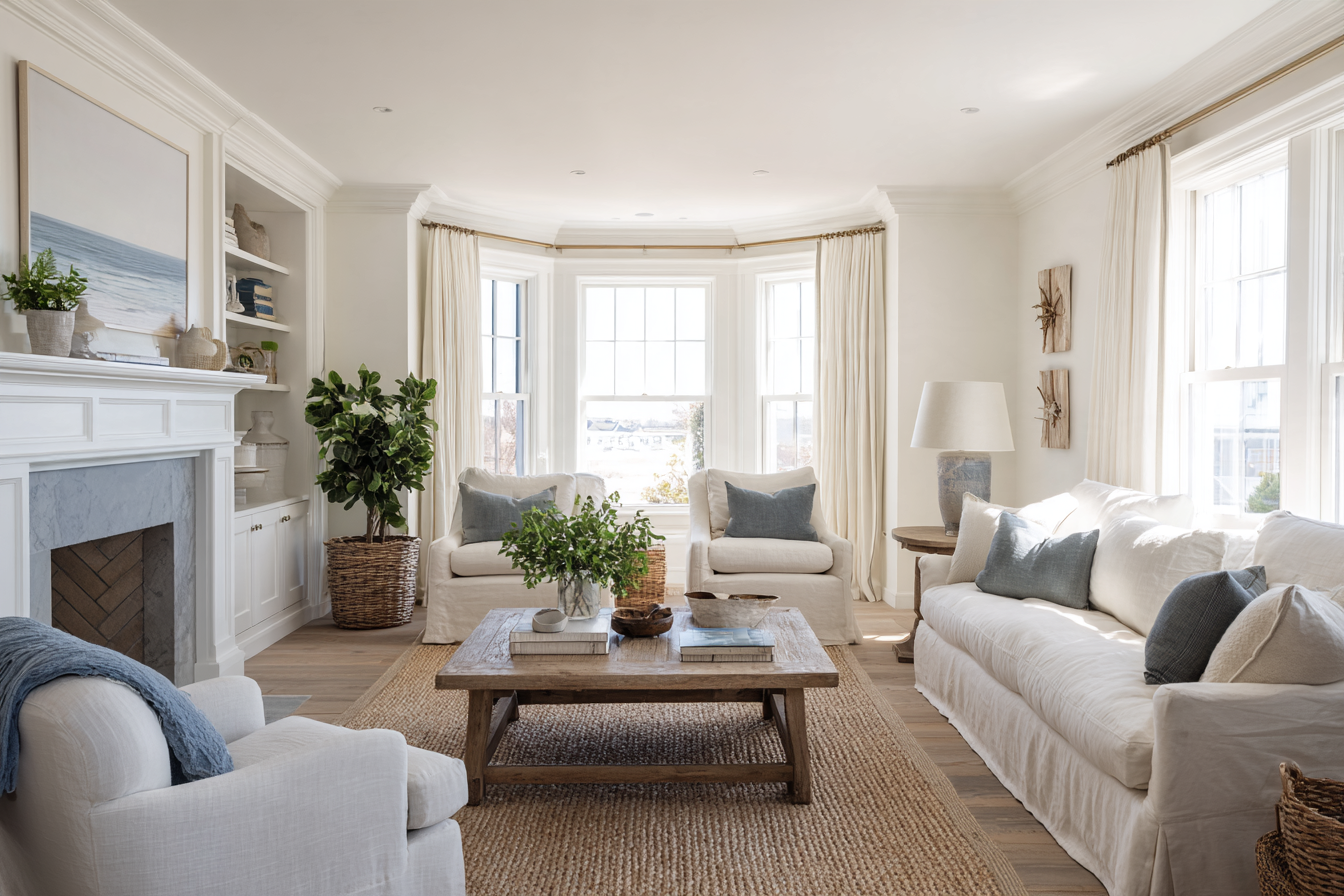
Blue still has a place in a New England coastal home, but it should not be running the show. Think about using it as an accent color: pillows, decorative throws, coffee table books, artwork.
04 ———–
Why Texture Outworks Color
Ask any designer working in this style and they’ll tell you: the secret behind a successful coastal space isn’t behind the paint color, it’s in the texture.
Picture a room with linen-upholstered chairs, a woven rattan pendant overhead, a chunky wool rug, an oak coffee table with visible grain, and a stack of throw pillows in close-but-not-quite-matching tones. Even if every piece in that room is roughly the same shade of cream, it reads as rich and layered rather than flat—because the eye is responding to all those competing surfaces, not to color alone.
It’s also the easiest fix available when a room feels a little lifeless. Before reaching for a bolder paint color, try a textured rug, a woven light fixture, a linen slipcover. Nine times out of ten, that’s the missing piece, not the wall color everyone blames first.
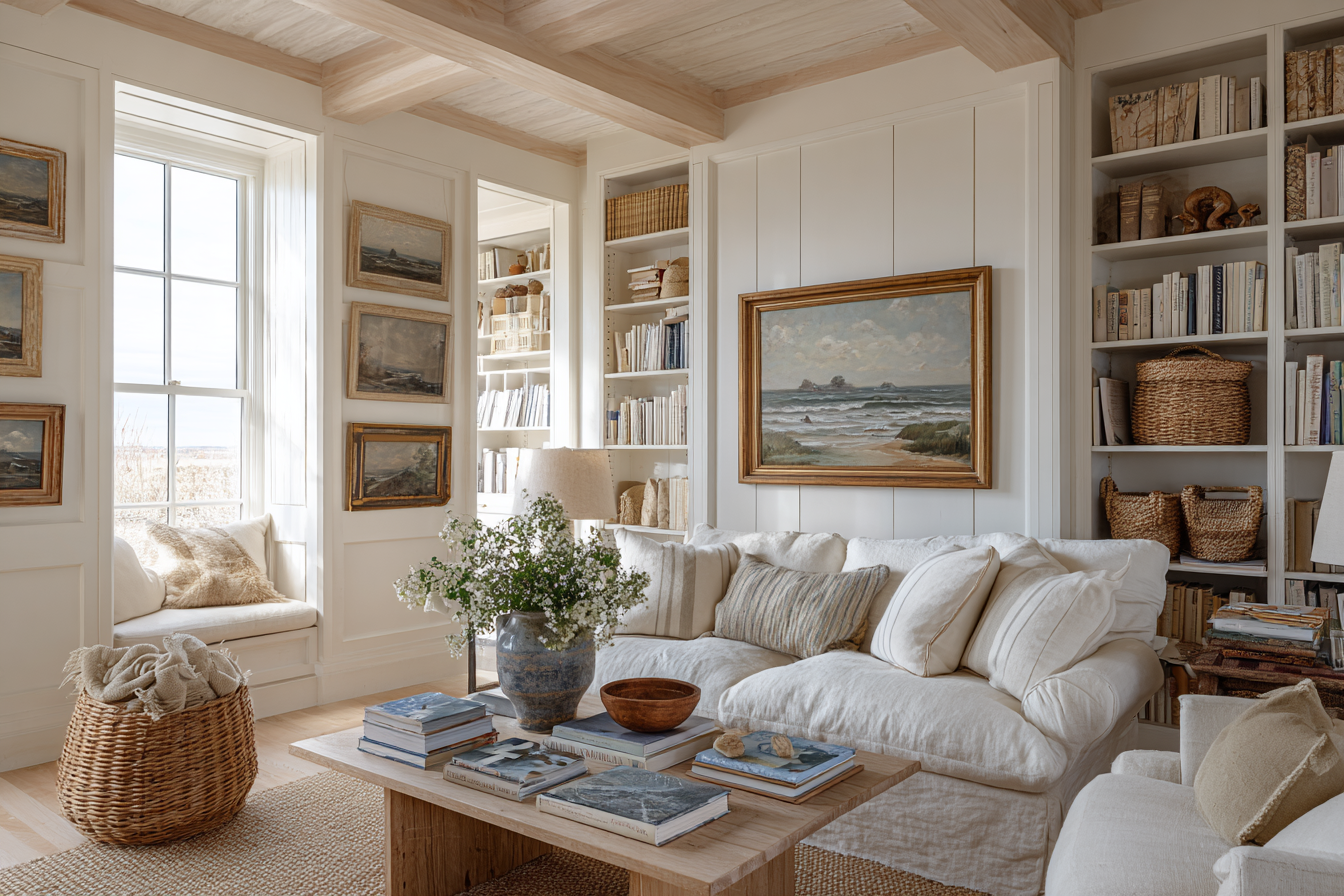
Even if every piece in a room is roughly the same shade of cream, it reads as rich and layered rather than flat—because the eye is responding to all those competing surfaces, not to color alone.
05 ———–
Let the Light Do Some of the Decorating
New England coastal homes have always been built around natural light: tall windows, deep porches, rooms oriented to catch the morning sun. That strategy should carry straight through into how a room gets decorated and organized, not stop at the architecture.
Skip the heavy drapes and choose something light enough to let the sun through—linen panels, simple woven shades, or nothing at all where privacy allows. And when arranging furniture, resist the instinct to push the biggest piece directly in front of the best window. The goal is a room that works with the outdoors and brings the outdoors inside, not one competing with it for attention.
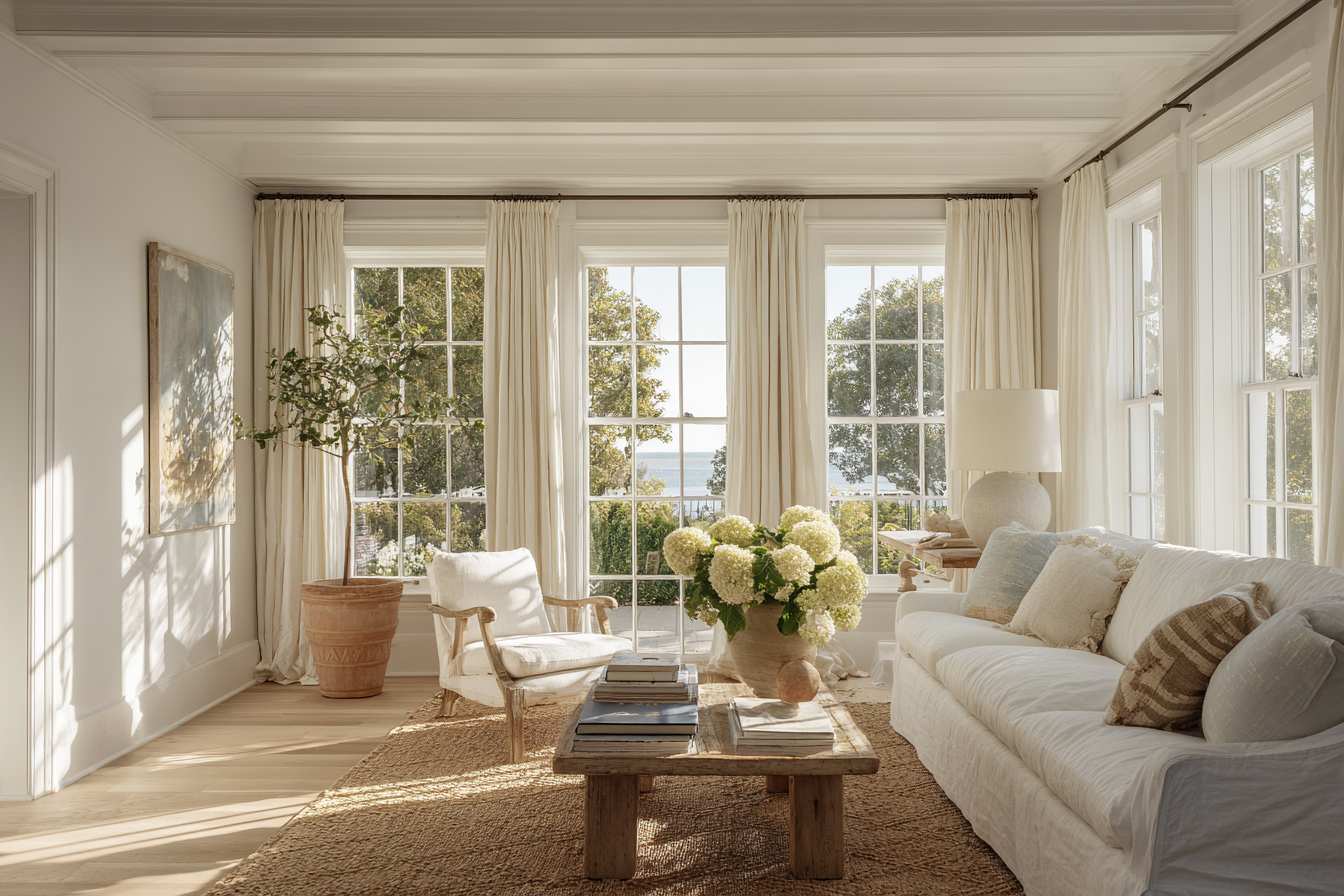
When choosing materials and drapery, choose materials light enough to let the sun through—linen panels, simple woven shades, or nothing at all where privacy allows.
06 ———–
How to Bring New England Coastal Into Your Home
Anyone starting from scratch should resist the urge to shop for decor first. The real decisions—the big, expensive, hard-to-undo ones—come first:
- Paint colors/wallpaper.
- Flooring.
- Textiles (curtains, rugs, upholstery).
- Lighting.
- Furniture.
These five things shape the feel of a room far more than anything placed on a shelf afterward. Get them right, and everything else tends to fall into place almost on its own. Get them wrong, and no amount of careful styling will fully cover for it.
07 ———–
An Architect’s Perspective: Architecture VS Accents
Permanent elements (architecture) always beat temporary ones (accents). A great, natural floor, a well-proportioned window, or solid trim work will carry a room for thirty years, while a throw pillow won’t carry it past next season.
Treat decorative objects such as vases, pillows, and seasonal touches as the easiest, cheapest things to swap out, and put your real investment into the parts of the house that aren’t going anywhere.
08 ———–
The Bottom Line: Coastal Design Is Classy, Not Beachy
The best New England coastal homes aren’t trying to look like a beach house. Most of them, it’s worth pointing out, aren’t even located on the water or in New England.
What they’re actually doing is simpler than the souvenir-shop version suggests: natural materials, a calm and varied palette, and a handful of smart architectural design choices, all working together to create somewhere that feels comfortable and a little timeless. An ocean view was never the requirement for a New England coastal home. The willingness to prioritize substance over decoration was.