STEAL THIS LOOK
A Complete Guide to
New England Coastal-Inspired Thanksgiving Styling
____________________
An architect’s guide to creating an elegant New England coastal-inspired Thanksgiving tablescape through thoughtful layers, harmonious color, natural materials, and the beauty of accumulated pieces.
NOVEMBER 7, 2026
BY: MARIA CEBAN


ON THIS PAGE:
Introduction
Begin With the Table Itself: The Foundation of the Composition
The Art of Table Linens: Understanding Texture, Drape, and Layering
Color Harmony: How to Choose a Thanksgiving Palette That Feels Traditional
Layering Dinnerware: Creating Depth Without Excess
Cutlery and Glassware: The Details That Complete the Setting
The Table Centerpiece: Understanding Scale, Height, and Proportion
Serving Pieces: Where Beautiful Styling Meets Practical Hospitality
The Art of Visual Rhythm: Repetition, Variation, and Simplicity
Designing for the Shape and Size of Your Table
The Final Layer: Lighting, Atmosphere, and the Dining Room Beyond the Table
Architect’s Perspective: Why the Most Beautiful Tables Are Also the Most Functional
The Bottom Line: The Thanksgiving Table, Reimagined
Thanksgiving tablescape is as meaningful as the holiday itself.
Long before the first dish is served, the dining room takes on a different character: the dining table becomes the center of the home, family heirlooms emerge from cabinets and cupboards, and the simple act of arranging plates, linens, and flowers becomes an expression of hospitality and love.
Nowadays, Thanksgiving decorating has become increasingly associated with elaborate centerpieces, curated seasonal decorations, and tablescapes designed primarily to be photographed instead of showing hospitality and love. Every element seems to require a theme, every place setting a decorative accessory, and every surface another reminder of the occasion. However, the most memorable Thanksgiving tables rarely depend on these things.
In timeless New England coastal homes, holiday decorating is an extension of the interior design rather than a temporary home transformation. For instance, antique wooden tables remain functional and partially visible beneath a natural linen tablecloth, inherited china is mixed with everyday pieces, and seasonal branches and flowers bring the changing landscape indoors. The atmosphere feels celebratory, but also homey, as though the table could have been assembled from objects collected over many years.
A beautifully designed table relies on many of the same principles that shape a successful interior space: proportion determines how objects relate to one another, color harmony creates cohesion, texture introduces depth, while repetition and variation establish rhythm. Above all, the arrangement must support the way the guests and the hosts use the table, not only be a photo-op. Whether your Thanksgiving gathering takes place around an antique dining table, a modest kitchen table, or a contemporary dining room, these principles remain the same.
This edition of Salt & Still’s Steal This Look explores how to put together a timeless Thanksgiving table from the foundation up, with advice on linens, dinnerware, cutlery, glassware, centerpieces, serving pieces, and five sophisticated holiday color palettes, because a coastal-inspired Thanksgiving table is not simply decorated – it is thoughtfully composed.
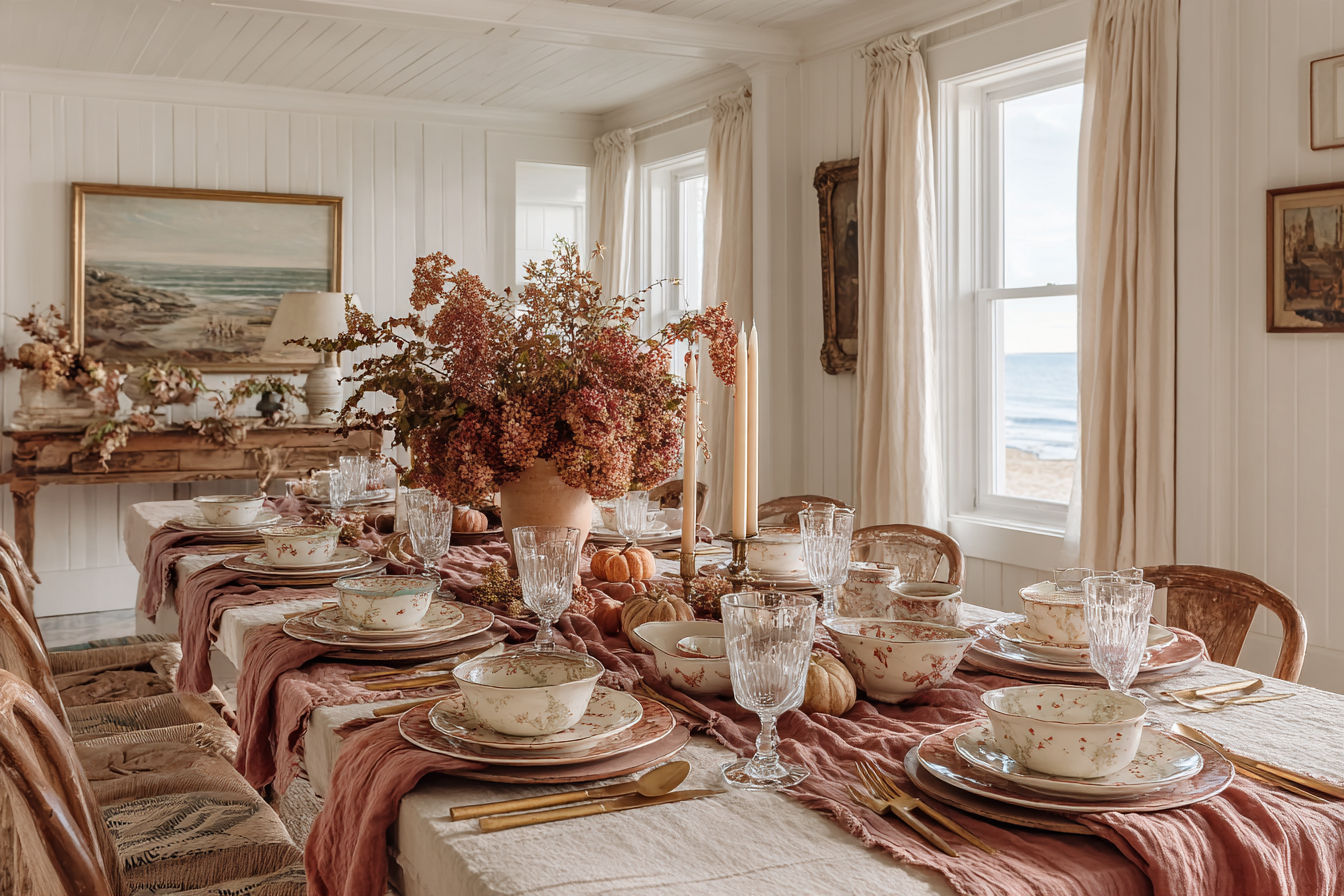
A beautifully designed table relies on many of the same principles that shape a successful interior space: proportion determines how objects relate to one another, color harmony creates cohesion, texture introduces depth, while repetition and variation establish rhythm.
01 ———–
Begin With the Table Itself: The Foundation of the Composition
Before selecting centerpiece elements, napkins, or dinnerware, think about the table itself, as its material, proportions, and relationship to the room it is in should inform every decision that follows.
A table made of natural wood brings warmth, texture, and visual depth to the room. As tempting as it may be, covering it entirely with a tablecloth will conceal one of the most beautiful elements in the room. Instead, consider adding a narrow linen runner or individual placemats that would protect the natural wood and establish a more intentional setting. A more contemporary table with a smooth surface may benefit from a full tablecloth, especially when the goal is to create a more intimate holiday setting.
The shape of the table is as important as its finish. A rectangular table naturally leans towards a linear room and tablescape arrangement, and it would work best with a runner, several small centerpieces, or several arrangements of candlesticks following its length. A round table naturally leans towards a centralized centerpiece that can be admired from every seat. Simplicity of the tablescape is especially important for round and smaller tables, and as tempting as it may be to introduce an elaborate centerpiece, instead consider the dinnerware and smaller accents to provide the decorations to avoid overcrowding the table.
The main lesson is: work with what the table has to offer instead of treating it like an entirely blank canvas.
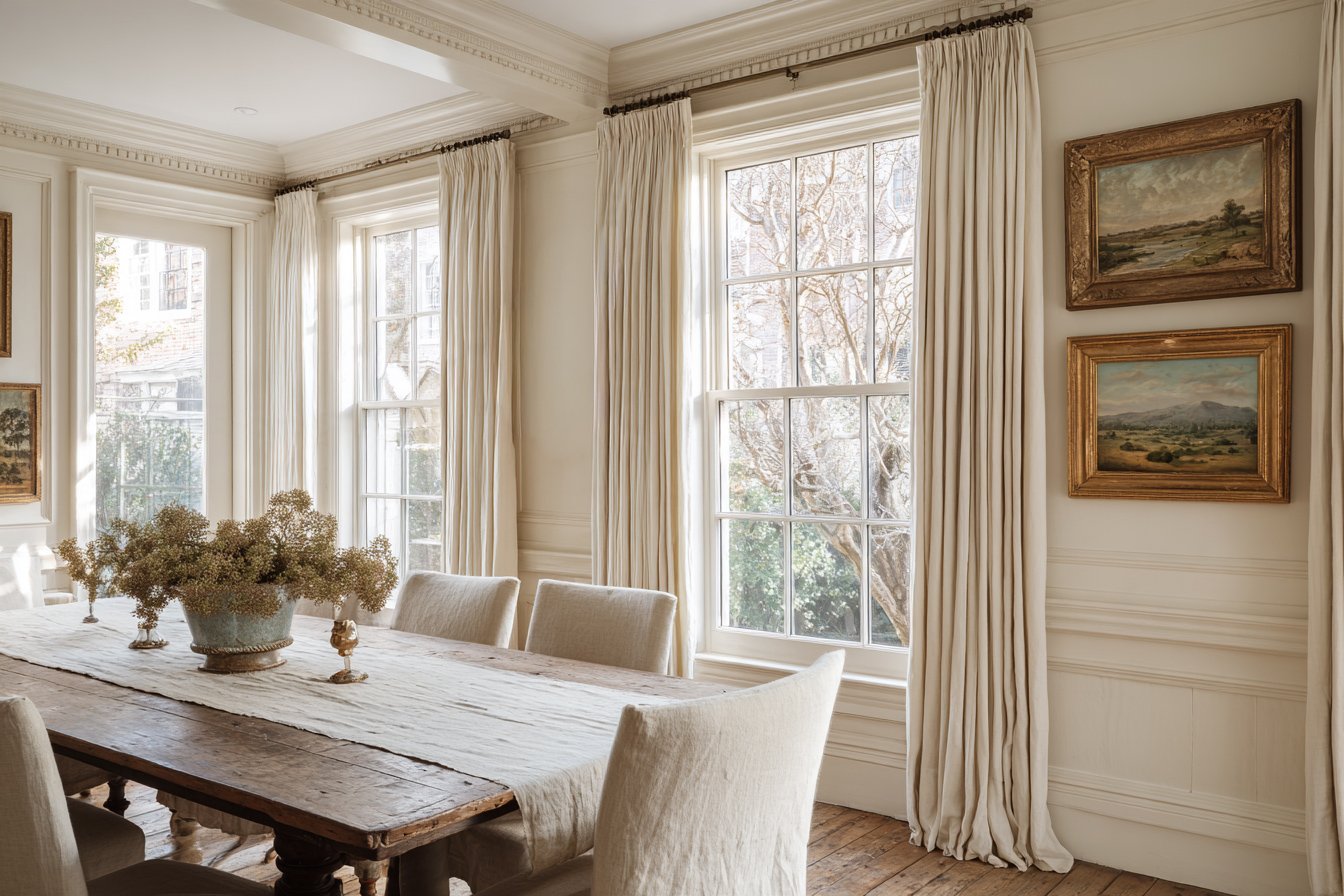
A table made of natural wood brings warmth, texture, and visual depth to the room. As tempting as it may be, covering it entirely with a tablecloth will conceal one of the most beautiful elements in the room. Instead, consider adding a narrow linen runner or individual placemats that would protect the natural wood and establish a more intentional setting.
02 ———–
The Art of Table Linens: Understanding Texture, Drape, and Layering
Table linens are the most influential design elements of any tablescape because they’re so prevalent. A curated tablecloth can soften a room, introduce color, or create a more formal setting; a runner creates a visual center while keeping the table beneath visible; and placemats offer opportunities to add organization to the table while introducing texture and contrast.
For a New England coastal-inspired Thanksgiving table, the most appropriate linens are made of natural fibers. For example, linen provides a visual elegance through its irregularities, cotton provides a more structured appearance due to its tightly knit fibers, and roughly woven fabrics can bring visual warmth to the table with their texture, without the use of bold patterns. The key to choosing linen material is to understand how the tablescape relates to other materials present in the room. A simple, smooth runner may be the best option for a richly grained wood table, while its smoother counterpart may benefit from linen with heavy texture.
Tablecloth or runner drop – the distance the fabric extends below the tabletop – is another important consideration. For a relaxed appearance, a drop of 8-12 inches will be sufficient. Longer drops may result in a more formal and put-together appearance; however, they may interfere with guests seated at the table.
Napkins are another opportunity to add layers to the tablescape. Instead of purchasing seasonal napkins, consider investing into linen napkins with various textures and patterns: checks, simple stripes, or deep colors that would complement the dinnerware.
The main objective with linens is not to match every textile but to choose textiles with enough variation that would create depth and enough similarities that would create a relationship between them.
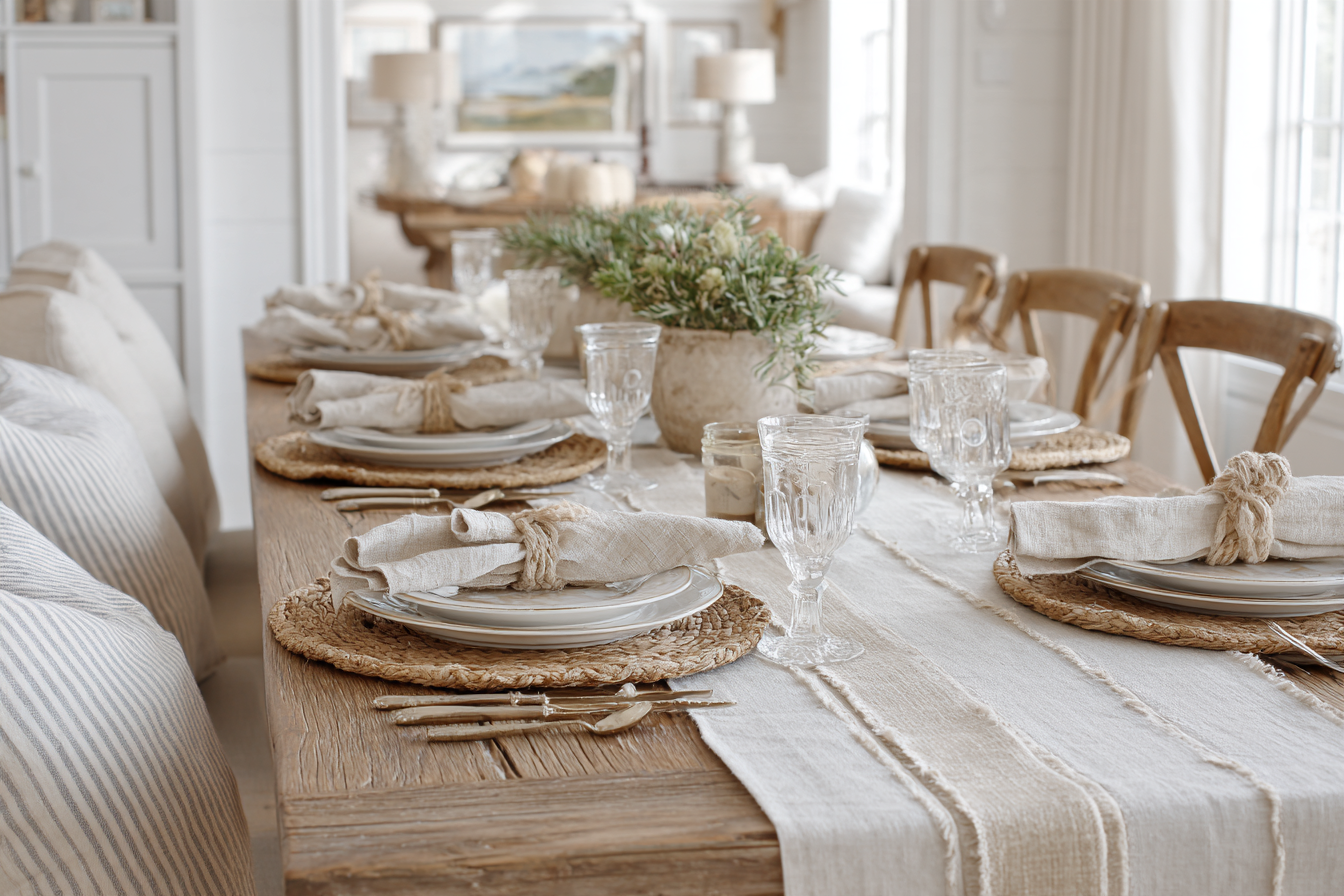
For a New England coastal-inspired Thanksgiving table, the most appropriate linens are made of natural fibers. For example, linen provides a visual elegance through its irregularities, cotton provides a more structured appearance due to its tightly knit fibers, and roughly woven fabrics can bring visual warmth to the table with their texture, without the use of bold patterns.
03 ———–
Color Harmony: How to Choose a Thanksgiving Palette That Feels Traditional
A thought-through Thanksgiving color palette must feel connected to the room surrounding it.
Instead of turning to a color palette typically associated with autumn, analyze the existing colors and undertones of the room where the gathering will take place. Pay attention to wood finishes, wall colors, upholstery, artwork, and dinnerware that will be used. Those elements provide the natural starting point, and from there the hierarchy of color and texture can begin.
The best approach to establishing a color palette is to choose one dominant color, one supporting color, and one accent color. The proportions do not have to be equal, but this formula will prevent colors from competing for attention.
It is also important to consider the relationship between the warm and cool tones. Warm colors create a sense of intimacy typically associated with a home, while cooler tones can introduce freshness, contrast, and formality. In New England coastal interiors, the most successful palettes contain both.
Palette One: Warm Ivory, Natural Flax, and Aged Brass
Palette One is the most versatile interpretation of a coastal-inspired Thanksgiving table, as it creates a neutral backdrop for bolder accents.
For example, warm ivory linens can create a soft foundation, while natural flax, wood, and aged brass introduce texture and warmth. In addition, white or cream dinnerware can keep the arrangement light, and a centerpiece of branches, greenery, and muted flowers can provide a subtle connection to the season.
The beauty of this palette lies in its simplicity. It creates depth through variation in material and finish, not color. This palette will work best in homes with light-toned walls, antique furniture, and natural wood finishes.
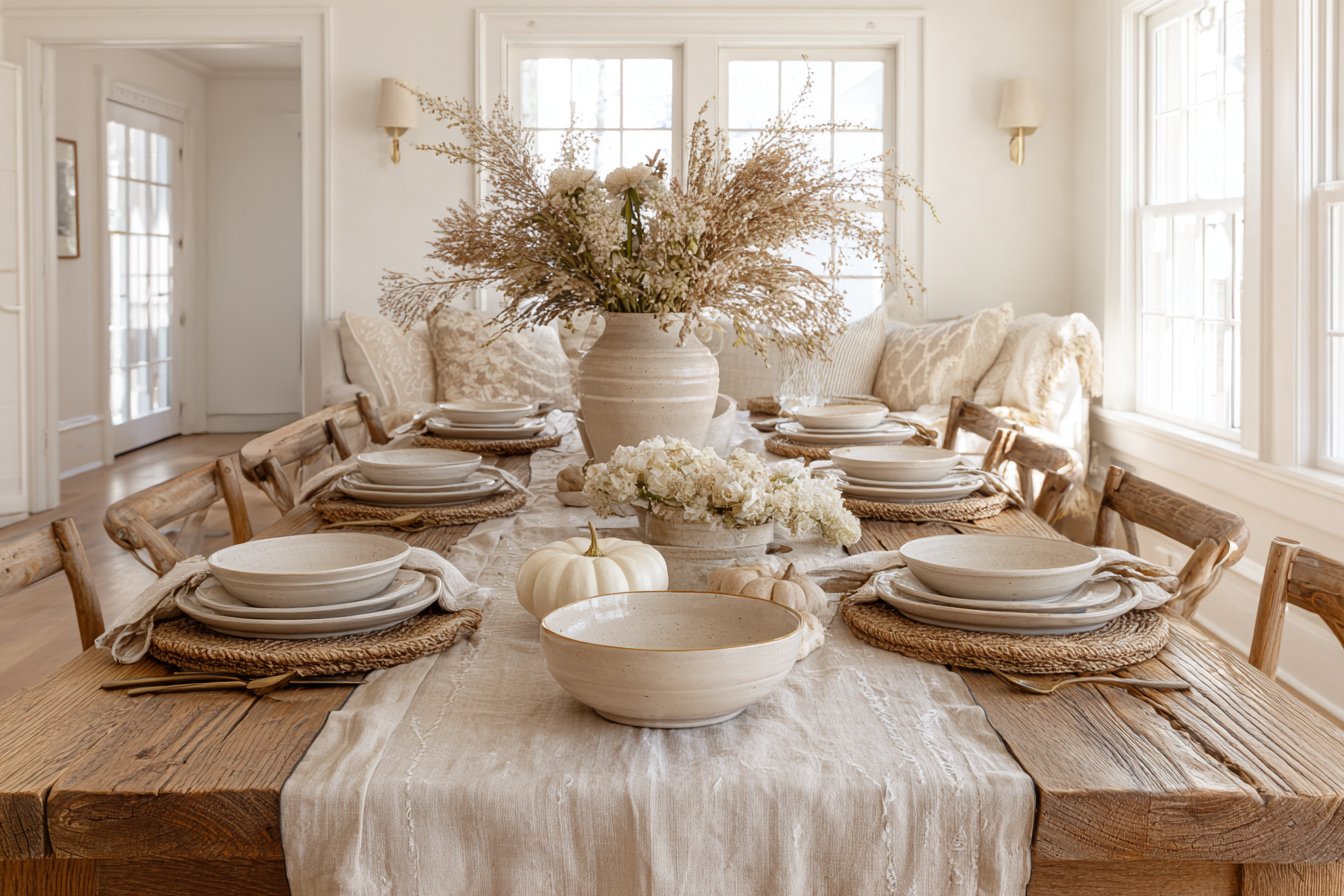
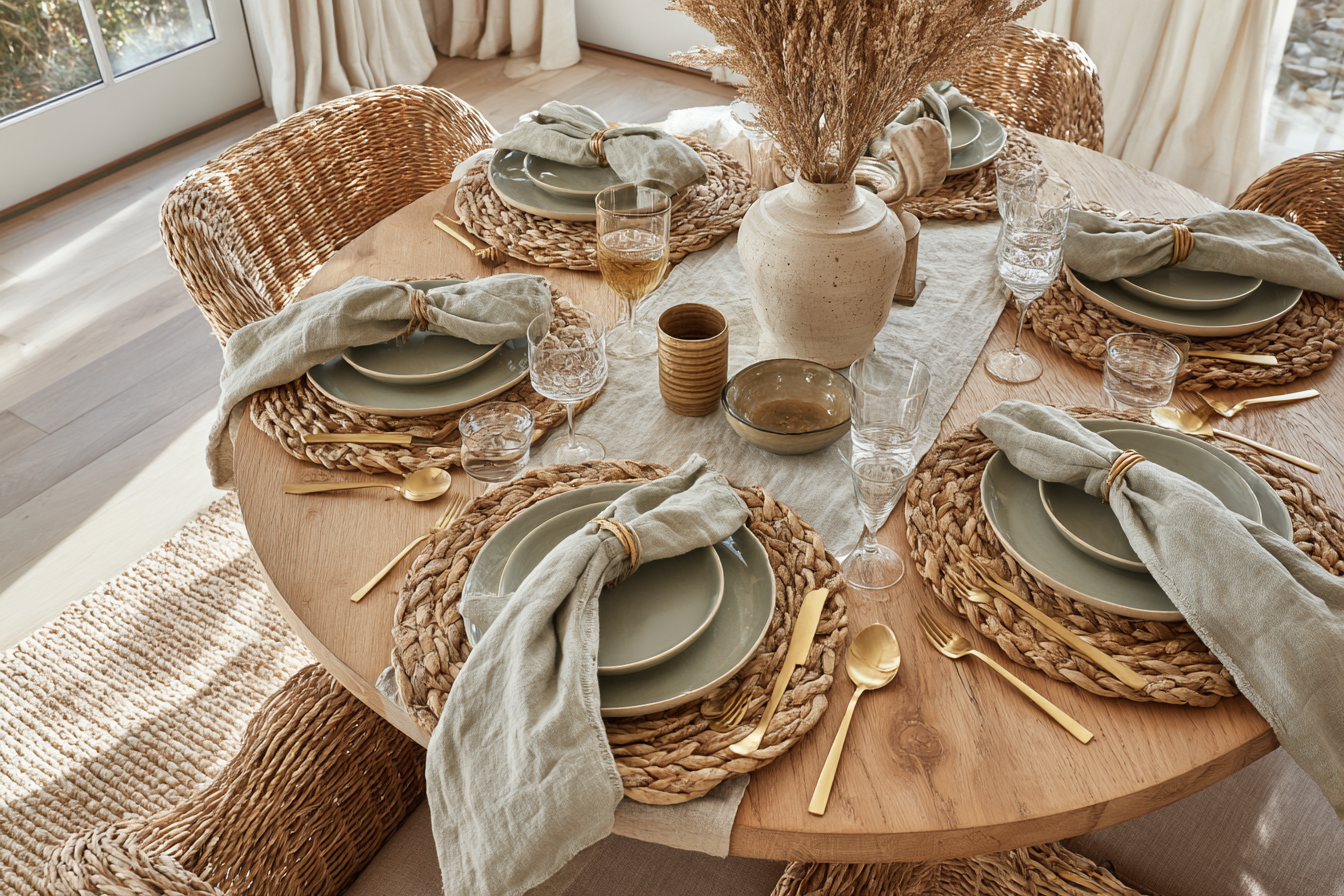
Palette Two: Muted Olive, Oatmeal, and Warm-Tone Wood
For a Thanksgiving table inspired by the coastal late-autumn landscape, muted olive and oatmeal create a sophisticated alternative to conventional seasonal colors.
In this palette, natural linen in an oatmeal color may become the foundation, while muted green napkins or dinnerware can introduce color accents. Warm-toned wood, ceramic accents, and a centerpiece of seasonal greenery and seasonal fruit can complete the composition.
This palette is earthy but not rustic, especially when paired with sophisticated cutlery and glassware.
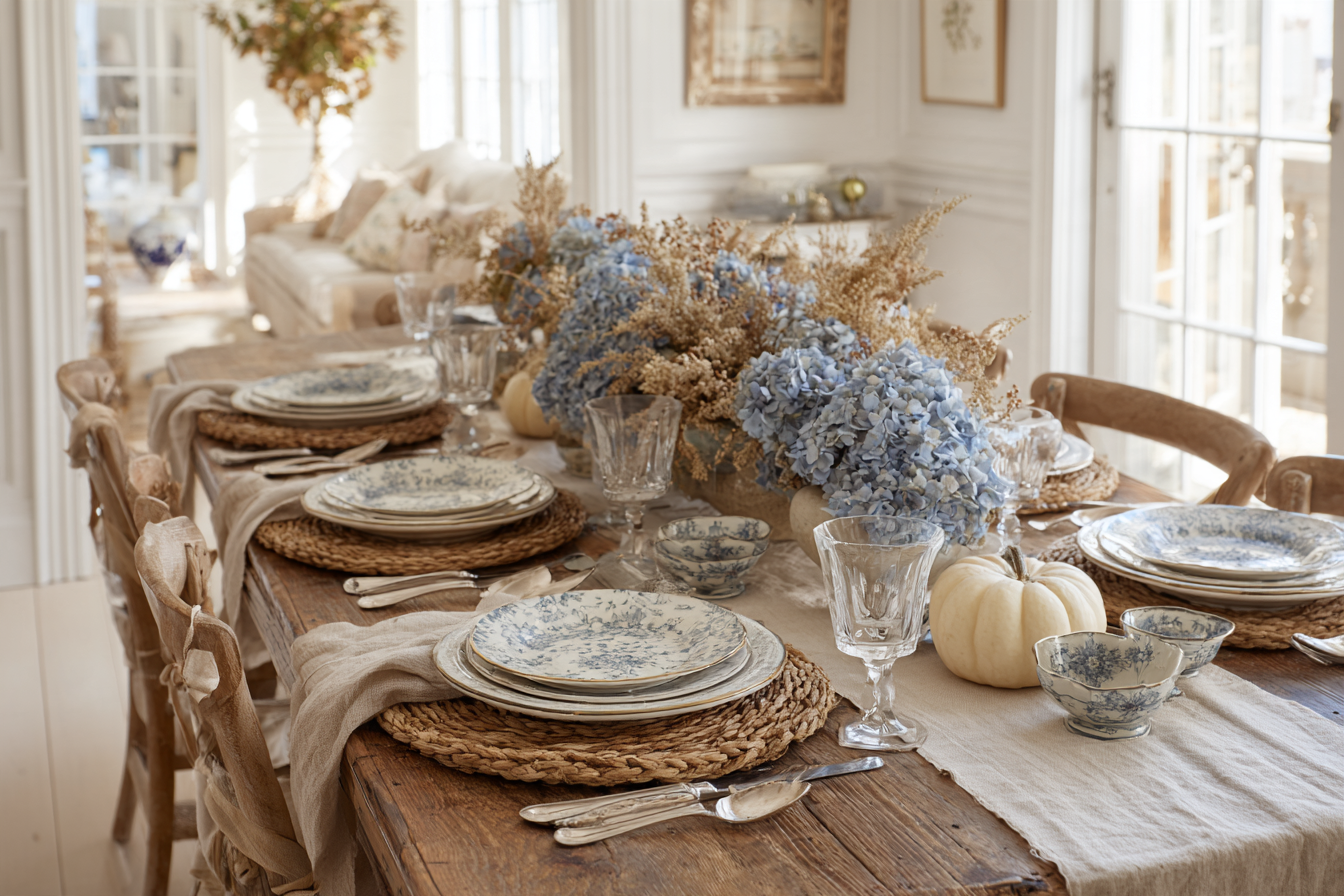
Palette Three: Faded Blue, Cream, and Aged Silver
Inspired by the well-known colors of the New England coast, Palette Three draws inspiration from blue-and-white china, worn textiles, and historic interiors.
In this palette, cream linens can create a warm foundation, while faded blue can appear through dinnerware, napkins, or an occasional patterned textile. Aged silver can add a traditional metallic finish, and a centerpiece of natural branches or faded hydrangeas can provide seasonal texture.
The key to the success of this palette is to keep the blue muted rather than overly saturated to make it appropriate for autumn while maintaining the coastal character.
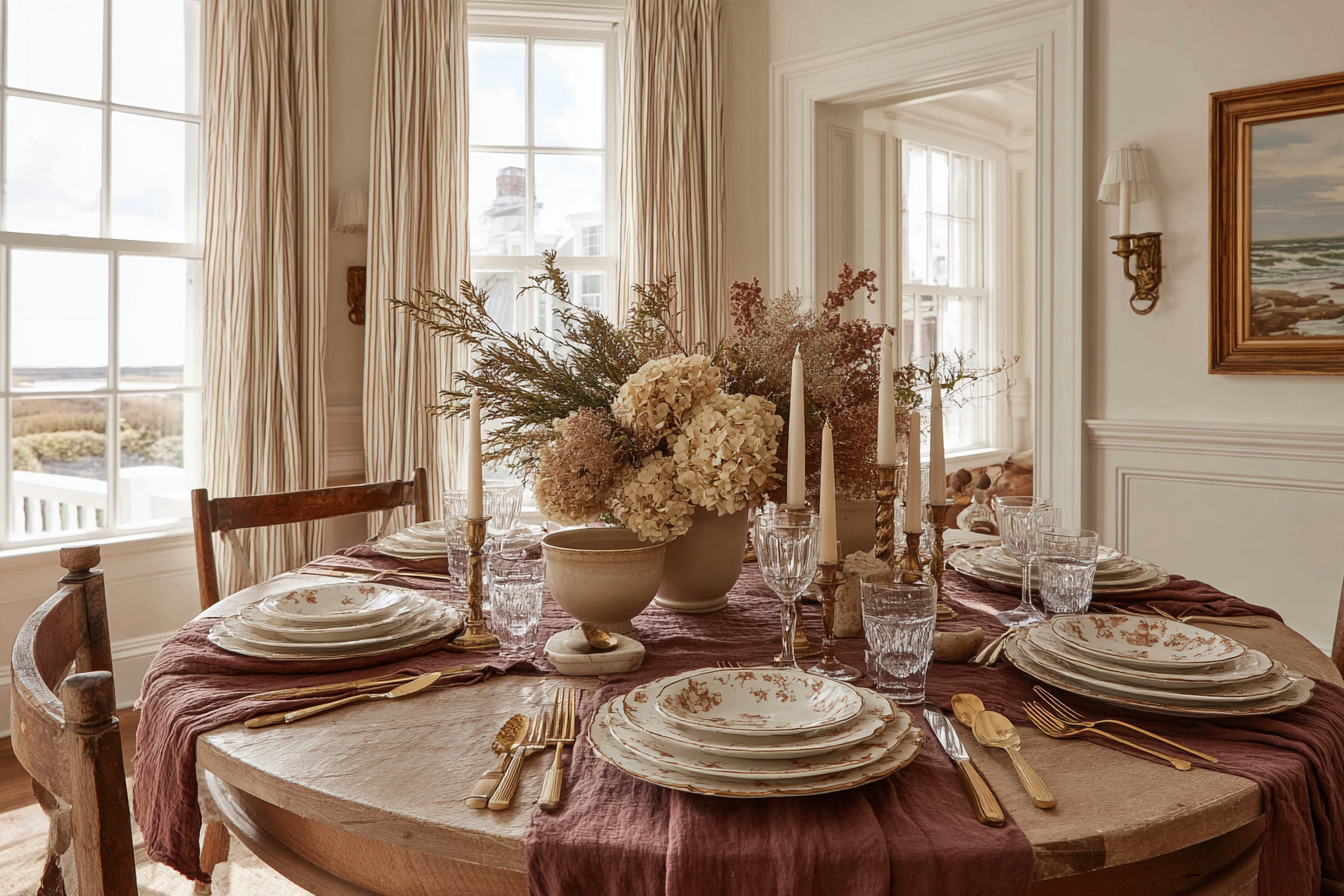
Palette Four: Tobacco Brown, Camel, and Soft Burgundy
For a richer, more traditional Thanksgiving table inspired by the colors of November on the coast, consider a palette of tobacco brown, warm camel, and soft burgundy. These colors work well in a home with antique wooden furniture, aged brass, and ivory ceramics.
On their own, each of these colors are bold and may compete against each other if not used thoughtfully. Burgundy can be selectively used in centerpieces, napkins, or small accents. Tobacco brown and warm camel can either also shine as accent colors or be introduced in tablecloths, dinnerware, or glassware. Depending on the amount of dark colors used and their placement, this palette will benefit from light colored elements, such as dinnerware and glassware, to avoid making the composition heavy.
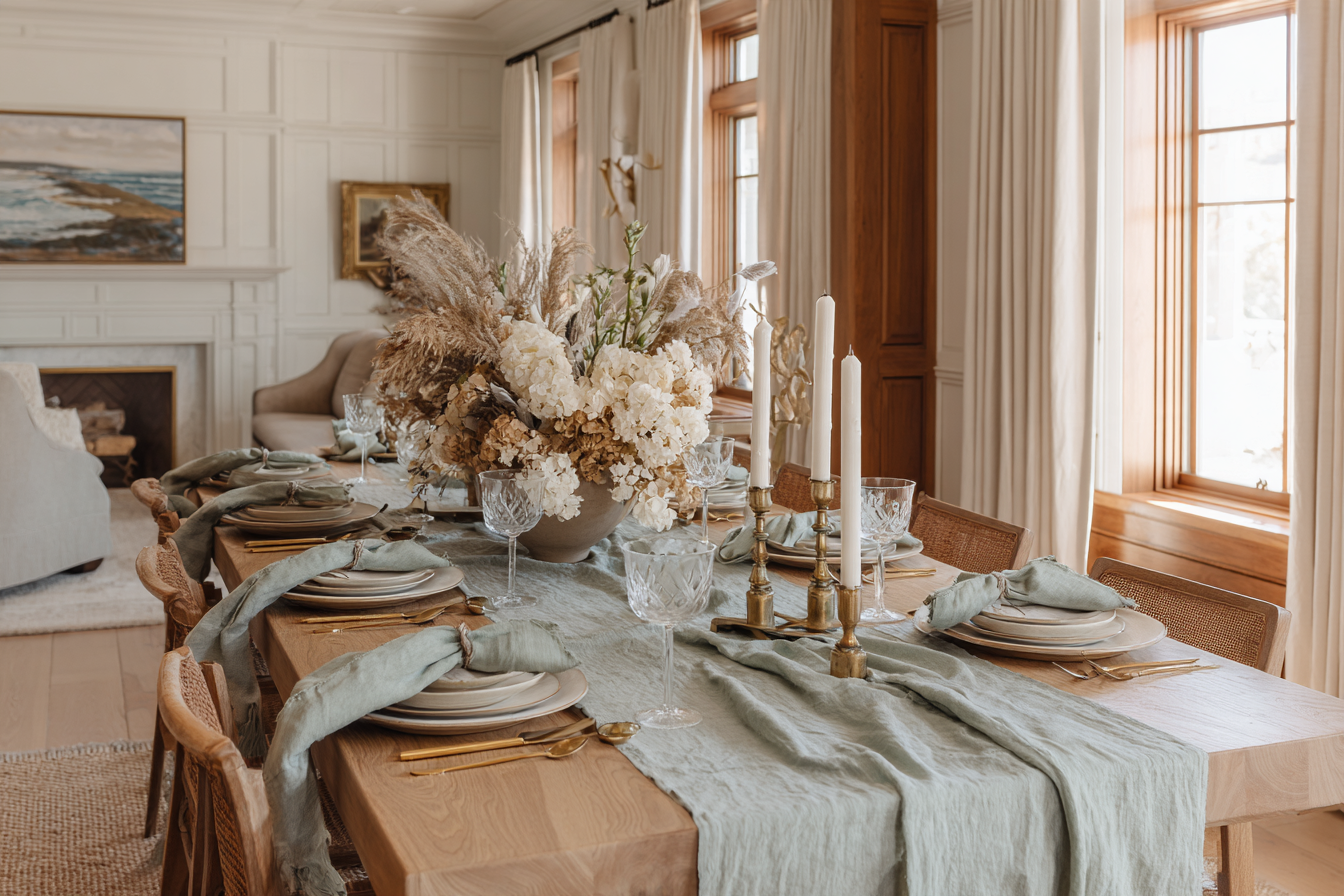
Palette Five: Stone Gray, Parchment, and Dusty Sage
Palette Five creates a contemporary coastal setting and keeps the space soft and balanced.
Stone gray and parchment are the two colors that would do well as a foundation, while dusty sage, on the other hand, can act well as an accent. Pale ceramics, linen, and warm-toned wood will help to maintain a soft appearance. A centerpiece of pale greenery and a few cream-colored flowers can provide enough seasonal character without introducing additional colors.
This elegant palette will be particularly successful in light-filled gathering spaces with a relatively simple appearance.
04 ———–
Layering Dinnerware: Creating Depth Without Excess
Once the linens and color palette are established, dinnerware becomes the next important functional and design layer.
Plates introduce shape and pattern to the tablescape. A common mistake is assuming that every place setting requires several stacked plates to appear sophisticated and layered, while in reality, the number of plates must be dictated by the meal being served, not the design.
While layering plates, consider the visual contrast that can be created by plates of different colors and patterns. For example, a patterned salad plate can sit beautifully above a simple ivory dinner plate, or a patterned dinner plate may be better paired with a plain smaller plate. The goal of layering is to establish visual interest without making the setting too noisy.
When putting together a dinnerware set, avoid the temptation to buy a matching set. At first, turn to family heirloom china and other pieces you already own, and then consider purchasing vintage pieces combined with simple and contemporary ceramics. As long as all pieces are united by either a color family or a visual character, a perfect match is not required.
05 ———–
Cutlery and Glassware: The Details That Complete the Setting
Cutlery and glassware may appear secondary to the tablescape elements, but they contribute greatly to the table’s overall balance and functionality.
Silver and stainless steel cutlery work well with most Thanksgiving palettes. Aged silver introduces a softer, collected character, while simple contemporary flatware creates a cleaner appearance.
For a basic place setting for every guest, position the dinner fork to the left of the plate and the dinner knife to the right, with the cutting edge facing inward, and add a spoon only when the menu requires one. For multiple courses, arrange the utensils in the order they will be used, working from the outside toward the plate. There is no need to introduce unnecessary cutlery only to create a more formal appearance of the table.
Glassware should be thought through as well. Clear water glasses and traditional wine glasses with long stems provide a timeless foundation. Vintage etched glassware can add a subtle detail, while simple contemporary glasses may be more appropriate for a modern-inspired setting. Position the water glass above the knife, slightly to the upper right of the plate, with any additional beverage glass nearby. Avoid overcrowding the setting with multiple glasses unless the meal requires them.
06 ———–
The Table Centerpiece: Understanding Scale, Height, and Proportion
The centerpiece is typically the largest and boldest element of a Thanksgiving table, but it should never overwhelm the composition and should never affect the table’s performance.
From an architectural perspective, a centerpiece is a focal point. Its size, height, and relationship to the surrounding objects determine how successfully it integrates into the table. A centerpiece that is too large can make the table feel crowded, while the one that is too small may appear disconnected from the adjacent place settings.
The solution begins with the proportion of the table itself. For a rectangular table, consider the relationship between the centerpiece and the table’s length. A single arrangement may work beautifully on a shorter or circular table, while a longer table often benefits from several smaller compositions arranged along its center. For a round table, a centralized arrangement can establish balance, but it should leave enough room for dinnerware and serving dishes.
The height of the centerpiece is especially important. A large floral arrangement positioned directly at eye level can interrupt conversation between the guests, so for seated dining, low arrangements are often the most practical choice. A rule of thumb is to keep dense centerpiece elements 12–14 inches high or lower, although the ideal height depends on the table size and shape, seating, and arrangement. Taller, slender elements can sometimes work if they do not obstruct sightlines.
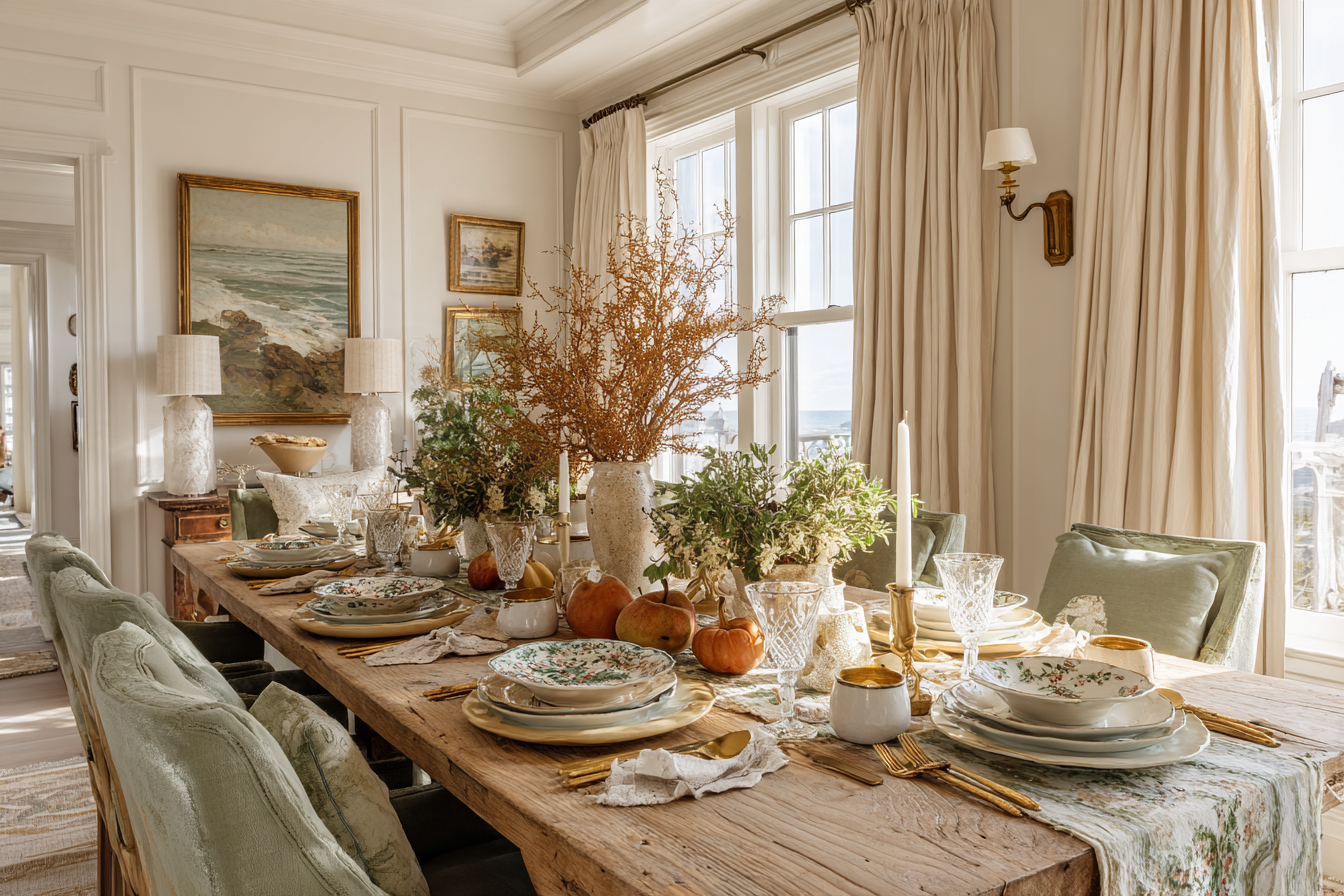
Natural Centerpieces
Natural centerpieces can create beautiful table arrangements using tree branches, seasonal fruit, and greenery set in elegant vases, without relying on elaborate floral arrangements.
Most importantly, the arrangement should feel organic instead of perfectly symmetrical, as it is inspired by nature.
Floral Centerpieces
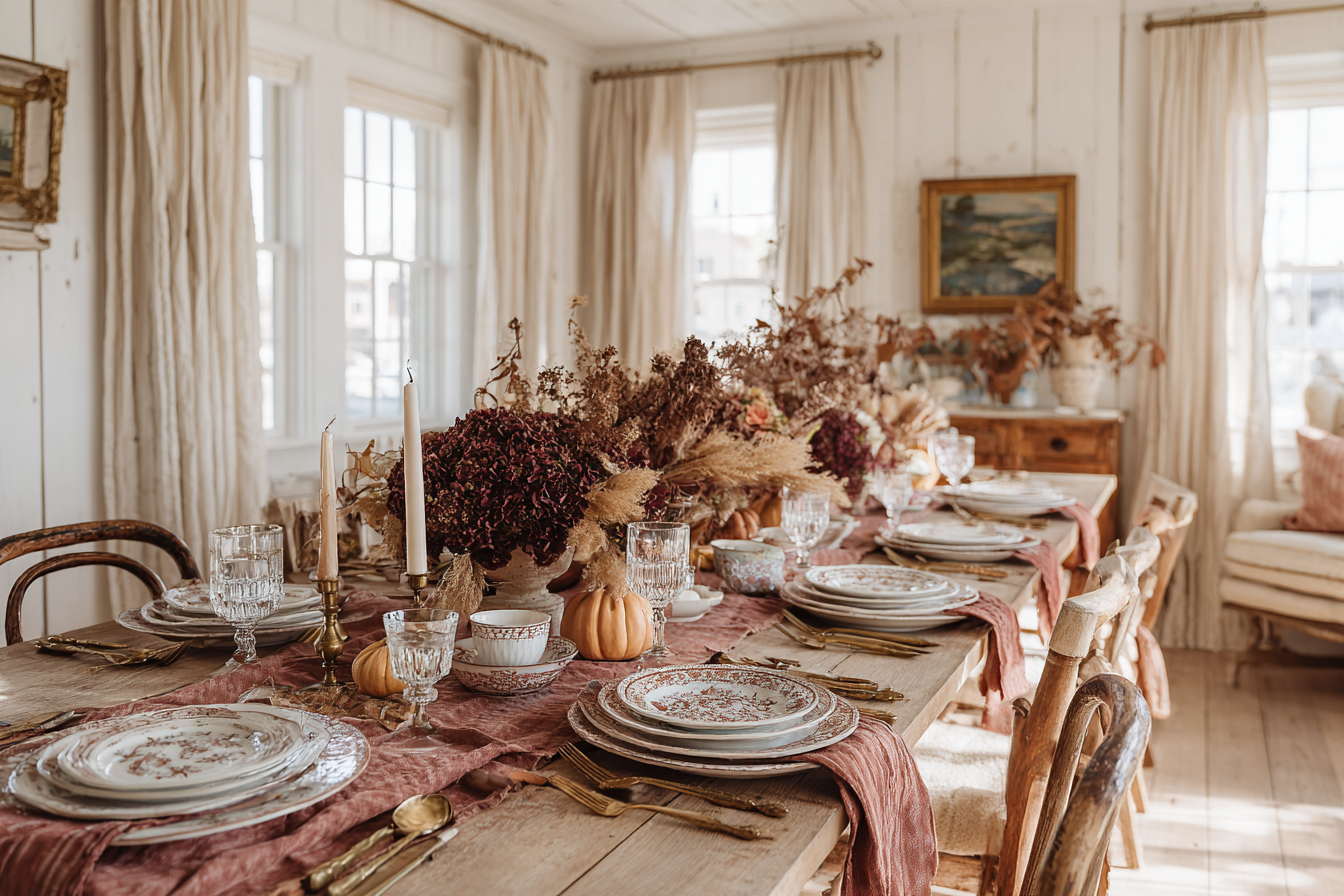
Flowers can create a softer, more romantic interpretation. Faded hydrangeas, dark chrysanthemums, cream-colored blooms, and seasonal greenery work particularly well in New England coastal interiors.
Rather than choosing bright, highly saturated arrangements, choose flowers that reflect the subdued colors of the autumn landscape. Several smaller arrangements can be more practical than one large bouquet, especially on a long dining table. On a round table, one arrangement will most likely be sufficient.
Candlelit Centerpieces
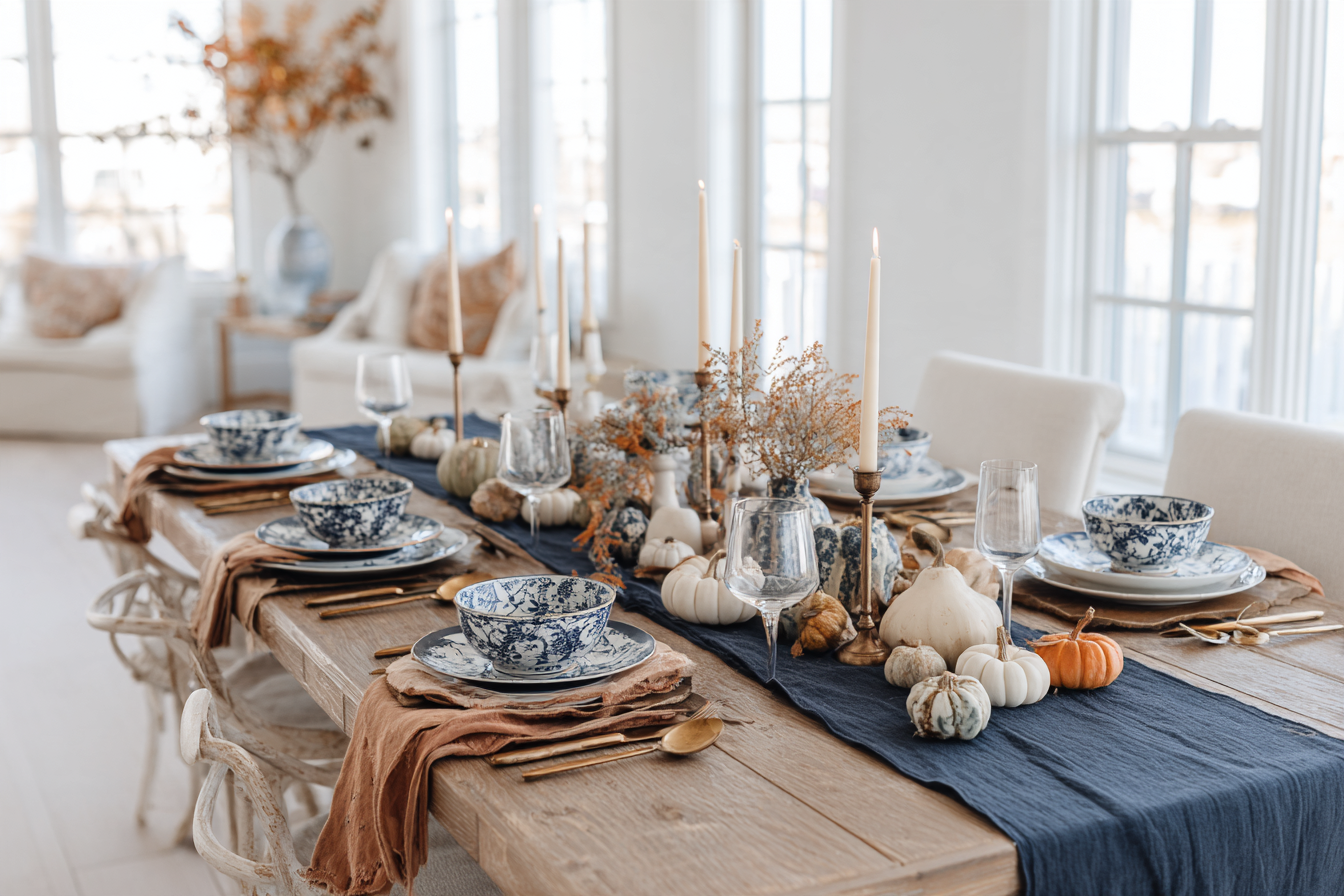
Candles introduce warmth and height to the table, creating a sense of occasion without requiring elaborate decoration.
Traditional candle holders made of brass, silver, or ceramic can be arranged in small groups or repeated along the table. Varying their heights creates rhythm, but avoid placing candles where they obstruct conversation or interfere with serving dishes. Keep flames safely away from greenery, flowers, and textiles, and use stable holders.
07 ———–
Serving Pieces: Where Beautiful Styling Meets Practical Hospitality
A Thanksgiving table is not complete until it is set with the holiday meal.
Serving dishes are often forgotten during the styling process, yet they occupy a large portion of the table and influence its final composition, so before arranging decorative objects, consider how the food will be served.
For a family-style meal, the table may need to accommodate a turkey platter, serving bowls, gravy boat, bread basket, and additional dishes. These elements require a significant amount of space, which may require table decor to be kept to a minimum. For buffet-style dining, the serving pieces can remain on a sideboard or separate surface, allowing the table to accommodate a larger centerpiece.
Similar to the dinnerware, serving dishes do not have to match each other or the dinnerware itself. Stoneware, ceramics, and natural wood can be combined as long as they match either in color tone or shape. As for the arrangement, a large oval platter housing the main food course will naturally become the focal point, while smaller dishes, baskets, and other serving pieces will support it and create visual balance.
A trick to creating a well thought through setup is to establish the dinner menu first, and then consider how every dish will be served. This will ensure that every dish gets enough serving space, and that the overall arrangement remains practical.
08 ———–
The Art of Visual Rhythm: Repetition, Variation, and Simplicity
In architecture and interior design, visual rhythm is created through the repetition of forms, colors, materials, or proportions.
A dining table naturally creates repetition through its place settings – plates, glasses, and cutlery appear at regular intervals, creating a sense of order. The centerpiece can reinforce this rhythm – a sequence of small floral arrangements, repeated candlesticks, or evenly spaced natural elements can create continuity along the table.
However, repetition should not become rigid. A perfectly symmetrical arrangement can feel formal, while subtle variations in height and shape introduce a more relaxed character, and the most sophisticated tables often combine both.
Consistent place settings provide structure, while the centerpiece introduces a more organic composition. This balance is very effective in New England coastal interiors, where traditional architectural order is often softened by natural materials and collected furnishings.
Simplicity is equally important – not every element needs to be decorative. If the dinnerware is patterned, the linens can remain simple, and if the centerpiece is elaborate, the surrounding accessories should be quieter.
The goal of visual rhythm is to create a clear visual hierarchy, because a table becomes more beautiful when the eye understands where to focus.
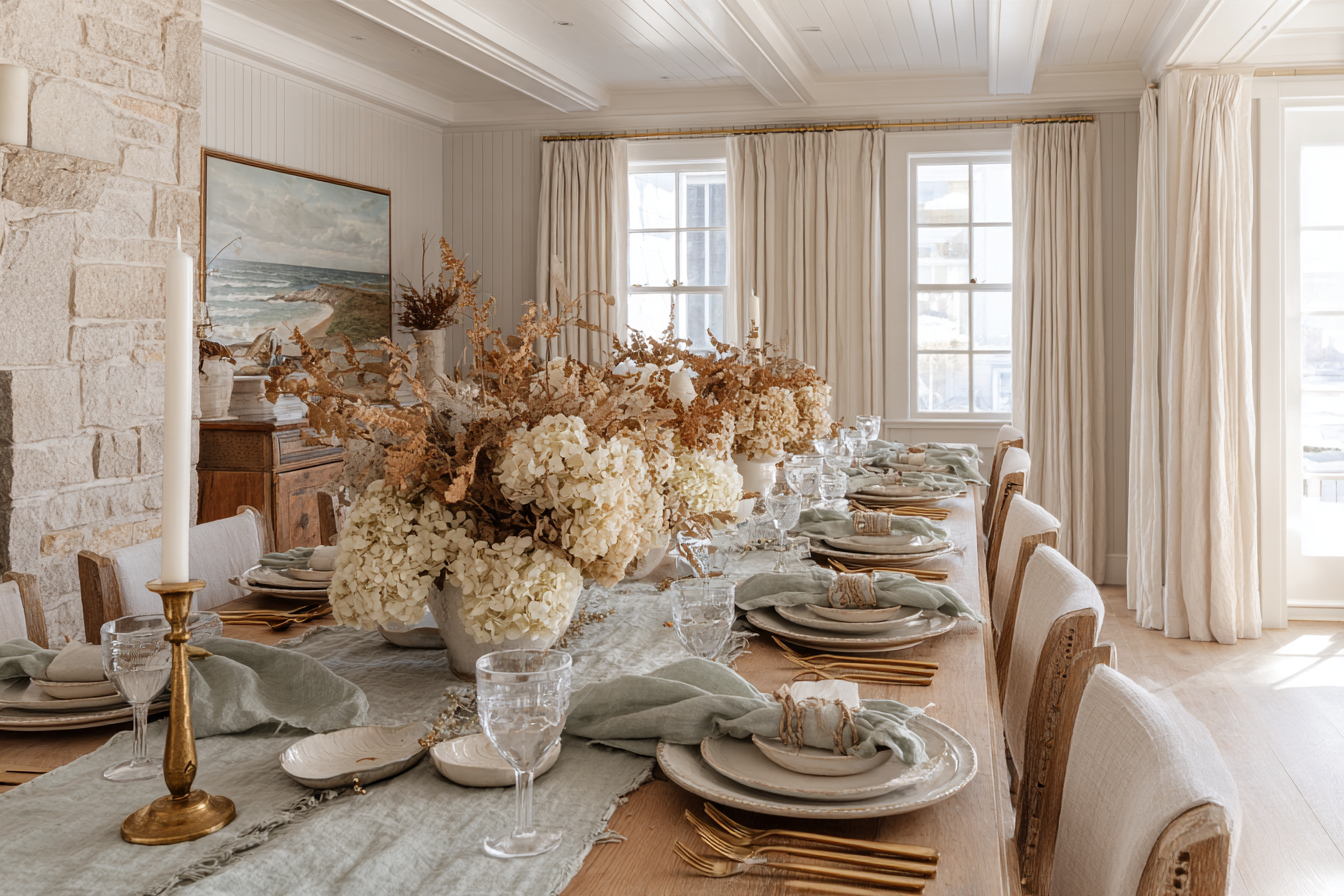
A dining table naturally creates repetition through its place settings – plates, glasses, and cutlery appear at regular intervals, creating a sense of order. The centerpiece can reinforce this rhythm – a sequence of small floral arrangements, repeated candlesticks, or evenly spaced natural elements can create continuity along the table.
09 ———–
Designing for the Shape and Size of Your Table
A successful tablescape should respond to the proportions of the dining table rather than follow a fixed decorative formula.
For a small rectangular table, a narrow runner, small centerpiece, and simple place settings may provide enough interest. For a long table, several smaller arrangements can create rhythm without producing one oversized focal point. For a round table, a central composition typically works best, although the arrangement should remain low enough to support conversation between guests.
Allow approximately 24 inches of table edge per guest, with additional space preferable for more elaborate place settings. Behind dining chairs, 36 inches of clearance is a useful planning starting point, with more room desirable where people must walk behind seated guests. These dimensions are guidelines rather than universal requirements, but they help ensure that the table remains comfortable and functional.
10 ———–
The Final Layer: Lighting, Atmosphere, and the Dining Room Beyond the Table
Even the most carefully curated tablescape must be connected to what is beyond the dining room – the lighting, furniture, architectural details, and overall atmosphere influence how the tablescape is experienced.
During the day, natural lighting emphasizes every detail of the tablescape, while at night artificial lighting creates a more intimate setting. A chandelier or pendant can establish the table as the focal point, while lamps and sconces provide softer illumination around the room. Adding dimmers to fixtures is a particularly useful trick, as they will allow the atmosphere in the dining room to change throughout the gathering.
The room surrounding the table must be visually balanced – if the room is visually rich and layered, avoid excessive layering in the tablescape, as the two will compete for attention. The objective is to create a dining room that feels cohesive rather than a collection of separately decorated areas.
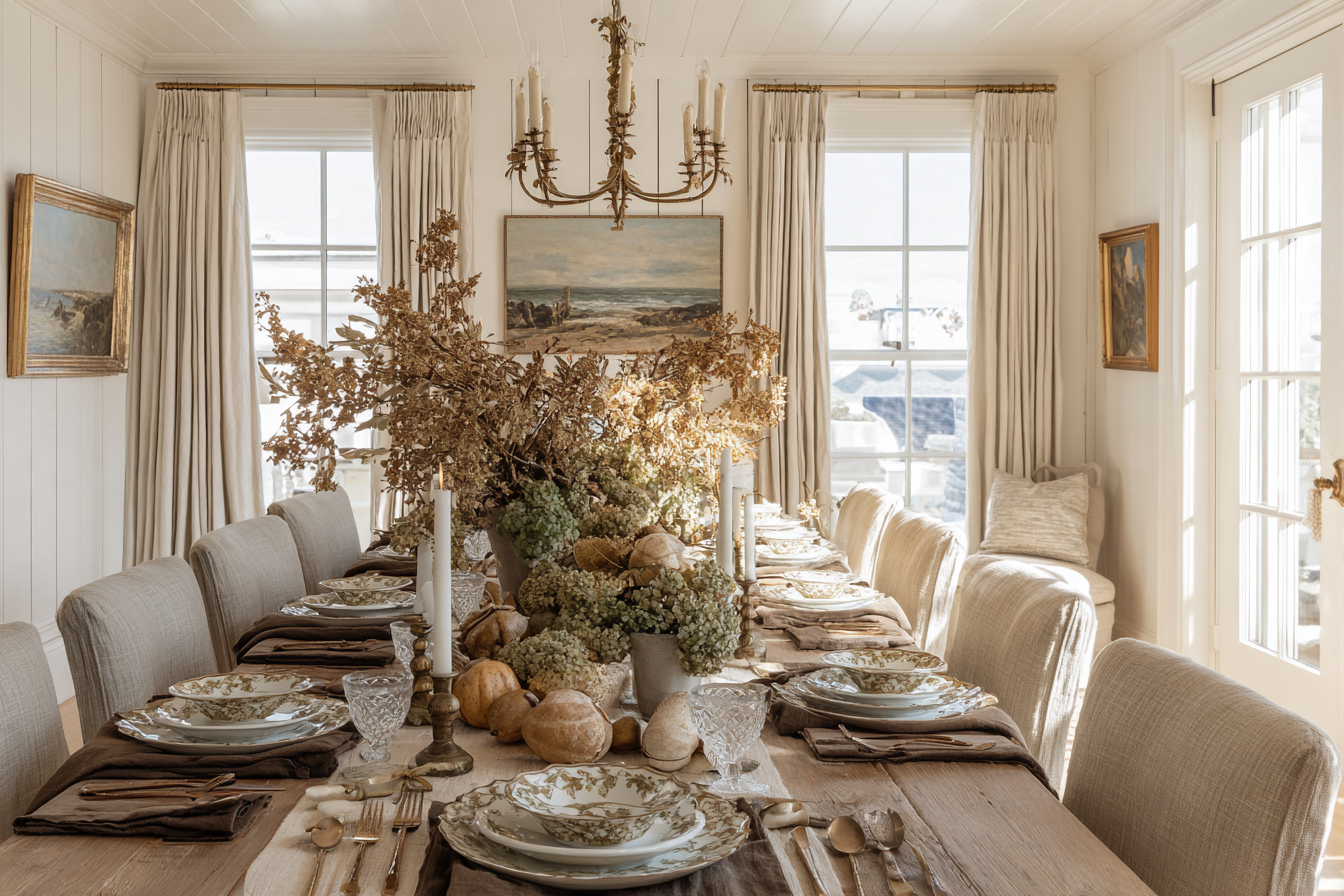
A chandelier or pendant can establish the table as the focal point, while lamps and sconces provide softer illumination around the room. Adding dimmers to fixtures is a particularly useful trick, as they will allow the atmosphere in the dining room to change throughout the gathering.
——————
Architect’s Perspective: Why the Most Beautiful Tables Are Also the Most Functional
A Thanksgiving table is a small-scale design project which requires an understanding of proportion, circulation, hierarchy, material relationships, and the way people interact with their surroundings and with each other. These are the same principles architects consider when designing buildings and interiors.
A centerpiece that obstructs conversation is a problem of scale and sightlines. A crowded table is a problem of spatial planning. An overwhelming combination of patterns and colors is a problem of visual hierarchy. Once these principles are understood, table styling becomes less about following trends and more about making thoughtful decisions.
The best Thanksgiving tables balance beauty with use and provide enough space for guests to sit comfortably, allow serving dishes to move naturally around the table, as well as create an atmosphere that encourages people to remain gathered long after dinner has finished. This is especially relevant to New England coastal design, where timelessness often emerges from the relationship between traditional forms, natural materials, and practical living.
——————
The Bottom Line: The Thanksgiving Table, Reimagined
The most elegant New England coastal-inspired Thanksgiving tablescapes are not necessarily the most elaborate or curated, but instead they are the ones that feel connected to family traditions, are intentionally compassed, and are designed around the experience of gathering.
Natural linens, curated dinnerware, thoughtful color palettes, and well-proportioned centerpieces create an atmosphere that feels celebratory without becoming overly themed. Serving pieces and practical spacing ensure that the table remains functional, while lighting and material contrast provide the warmth associated with the holiday. And perhaps most importantly, the setting should reflect the people who gather around it.
In the end, the art of setting a coastal-inspired Thanksgiving table is not about creating something entirely new each year – it is about finding beauty in what has been collected, making room for what matters, and creating a setting where people feel welcome to stay.